

What They Are, Their Rich History, and How to Create, Publish & Monetize Your Own
PART ONE
What Is a Coloring Book? A Deep Dive into History, Psychology & Appeal
Introduction: More Than Just Paper and Pencils
At its most basic, a coloring book is a collection of printed line drawings or outlines designed to be filled in with color using crayons, colored pencils, markers, paint, or digital tools. But reducing a coloring book to that simple definition is like calling a novel a collection of words — technically accurate, yet wildly incomplete.
Coloring books are therapeutic tools, educational resources, creative canvases, and cultural artifacts all at once. They have shaped how children develop fine motor skills, how adults manage stress, and how artists find their first creative voice. From a child hunched over a Crayola set at the kitchen table to a professional artist building a six-figure passive income stream on Amazon KDP, the coloring book spans an astonishing range of human experience.
This article explores what a coloring book truly is — tracing its surprising origins, charting its evolution over more than 150 years, examining the psychology behind its universal appeal, and explaining why it remains one of the most resilient and beloved publishing formats in the world.
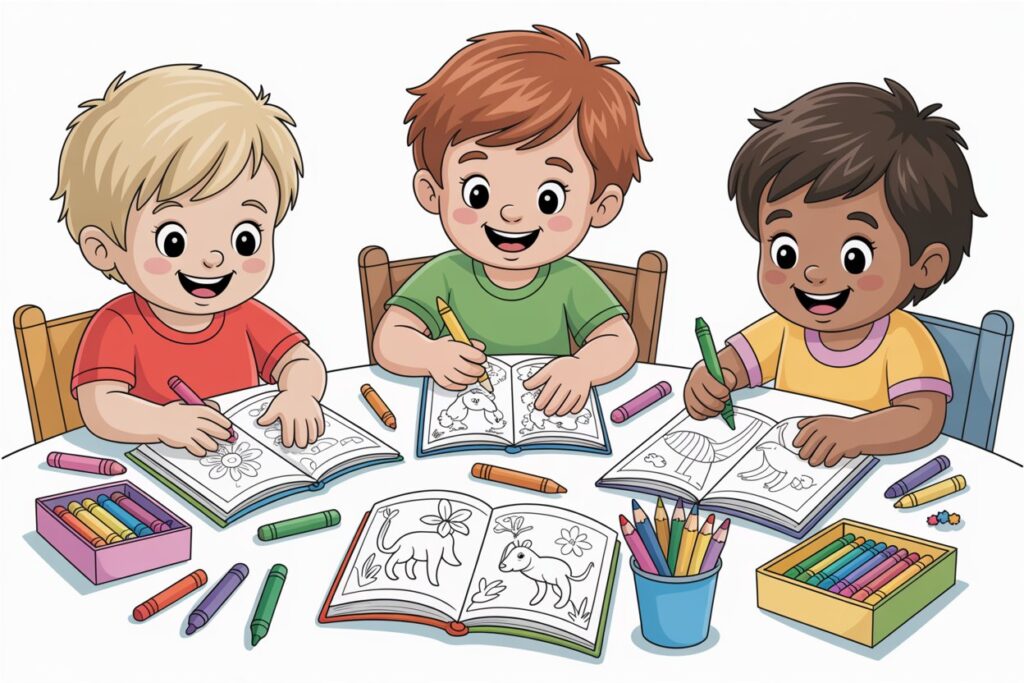
Defining a Coloring Book: Key Characteristics
A coloring book typically shares several defining characteristics regardless of its era or audience:
- Bold outlines or line art that define shapes, figures, patterns, or scenes
- White or light-colored spaces intended to receive color
- A binding format — traditionally stapled, spiral-bound, or perfect-bound
- A thematic focus, whether educational, recreational, artistic, or therapeutic
- Audience-specific complexity, ranging from simple shapes for toddlers to intricate mandalas for adults
Modern coloring books have expanded this definition considerably. Digital coloring books can be accessed on tablets, smartphones, and e-readers. Printable coloring pages sold as PDF downloads operate as single-page or multi-page coloring experiences. Some hybrid formats combine short narratives with coloring pages, blending storybook and activity book into a single product.
The Origin of Coloring Books: A Surprisingly Old Story
Most people assume coloring books are a 20th-century invention, but their roots reach back further than expected. The story of the coloring book is deeply tied to the industrialization of printing, the rise of childhood as a culturally recognized developmental stage, and the emergence of mass-market publishing.
The McLoughlin Brothers and the 1880s
The first commercially produced coloring books are widely attributed to the McLoughlin Brothers, a New York-based publishing house that dominated the children’s book market in the latter half of the 19th century. In the 1880s, they began producing books with black-and-white illustrations specifically designed to be colored by children. These early books were positioned as educational tools that combined artistic instruction with moral lessons.
The McLoughlin Brothers understood something powerful: children learn through doing. Giving a child a printed page to color engaged their hands, eyes, and imagination simultaneously. This was a radical pedagogical idea at a time when childhood education was still primarily rote memorization.
The Little Folks Painting Book (1879)
Some historians point to ‘The Little Folks Painting Book’ as one of the earliest examples of what we would recognize today as a coloring book. Produced in the late 19th century, it featured simple illustrations with guidance on which colors to apply — essentially a paint-by-numbers predecessor. The book was sold alongside watercolor sets, treating art as an accessible leisure activity for middle-class children.

The Crayola Effect: The Early 20th Century
The real explosion of coloring books as a mass-market phenomenon came with the introduction of Crayola crayons in 1903 by Binney & Smith. Suddenly, a clean, safe, affordable, and vividly colorful tool was in the hands of children across America and Europe. Publishers quickly recognized the commercial synergy: crayons needed coloring books, and coloring books needed crayons.
Throughout the 1910s and 1920s, coloring books became a staple of toy stores, five-and-dime shops, and mail-order catalogs. Themes typically mirrored popular culture of the day — nursery rhymes, farm animals, patriotic imagery, and early cartoon characters. By the 1930s and 1940s, licensed character coloring books featuring figures from radio programs and early films began to appear.
The Golden Age: 1950s–1980s
The postwar economic boom transformed coloring books into a cultural institution. Television created a new pipeline of beloved characters — Mickey Mouse, Bugs Bunny, Superman, Barbie — and publishers rushed to license these properties into coloring book form. The 1960s and 1970s saw coloring books branch into educational niches: alphabet books, number books, science books, and history books all adopted the coloring-page format to make learning more engaging.
During this era, the coloring book was definitively a children’s product. An adult seen using one would have raised eyebrows. That cultural assumption was about to change dramatically.
The Adult Coloring Revolution: 2012–Present
In 2012, Scottish illustrator Johanna Basford self-published ‘Secret Garden,’ an intricate coloring book filled with extraordinarily detailed botanical illustrations aimed explicitly at adults. The book became a global publishing phenomenon, eventually selling over 20 million copies worldwide and single-handedly creating an entirely new publishing category: adult coloring books.
Publishers scrambled to enter the market. Mandala coloring books, geometric pattern books, anti-stress coloring books, and fantasy-themed coloring books flooded bookstore shelves. By 2015, adult coloring books were dominating bestseller lists on Amazon, sometimes occupying five of the top ten spots simultaneously. The New York Times added a Manga and Graphic Books bestseller list partly in response to the coloring book boom.
This revolution was not a fluke. It reflected a growing cultural awareness of mindfulness, mental health, and the value of analog creative activities in an increasingly digital world.
The Psychology of Coloring: Why We Love It
Understanding why coloring books appeal so powerfully to humans requires a brief detour into psychology and neuroscience. The act of coloring engages multiple cognitive and emotional systems simultaneously, producing a distinctive mental state that many practitioners describe as deeply satisfying.

Flow State and Focused Attention
Psychologist Mihaly Csikszentmihalyi described ‘flow’ as a mental state of complete absorption in a challenging but manageable task. Coloring produces flow-like states because it demands just enough concentration to quiet the mental chatter of daily life without being so difficult that it causes frustration. The bounded nature of the task — there is a clear space to fill, a clear border to respect — provides psychological structure that feels safe and achievable.
Stress Reduction and the Amygdala
Multiple studies have demonstrated that repetitive, rhythmic creative activities reduce activity in the amygdala, the brain’s threat-detection center. Coloring, with its repetitive hand movements and predictable patterns, functions similarly to meditation or knitting in its ability to lower cortisol levels and induce a calm, focused state. This is the neurological basis for the explosion of ‘stress relief’ and ‘mindfulness’ coloring books marketed to adults.
The Power of Completion
Coloring books offer something increasingly rare in modern life: a clearly completable task with a satisfying visual result. In a world of infinite to-do lists and open-ended digital workflows, finishing a coloring page and seeing a beautiful image emerge produces a genuine sense of accomplishment. This completion dopamine hit is part of what makes coloring books so addictive for many people.
Child Development Benefits
For children, the developmental benefits of coloring are well-documented and span multiple domains. Fine motor skill development is the most obvious: guiding a crayon within the lines of an illustration builds the hand-eye coordination and finger strength that will later be essential for writing. But coloring also develops color recognition and discrimination, spatial reasoning, the ability to follow instructions, focus and patience, and creative decision-making.
Types of Coloring Books: A Comprehensive Overview
Today’s coloring book market is remarkably diverse. Understanding the main categories helps both consumers and creators navigate the landscape effectively.
Children’s Educational Coloring Books
These books combine coloring with explicit learning objectives. Alphabet and number coloring books, animal identification books, geography books featuring maps and flags, and science books showing diagrams of the human body or solar system all fall into this category. They are typically found in educational supply stores, school settings, and the children’s sections of bookstores.
Entertainment and Character-Based Coloring Books
Licensed from film studios, television networks, video game companies, and comic book publishers, these books feature beloved characters in scenes from their source material. They appeal to children’s desire to engage with the stories and characters they love in a new way. Examples range from Disney Princess books to superhero coloring books to books based on popular video games.
Adult Stress-Relief and Mindfulness Coloring Books
Descended from Johanna Basford’s revolution, these books feature complex, intricate illustrations — mandalas, botanical designs, geometric patterns, architectural details — that require sustained attention and offer no ‘right’ or ‘wrong’ color scheme. They are explicitly marketed for relaxation and mental wellness.
Many adults prefer fine-tip pens designed for adult coloring books to achieve precise, detailed results.
Fantasy and Themed Art Coloring Books
These books appeal to readers with specific aesthetic interests: fantasy landscapes, mythological creatures, steampunk machinery, celestial and cosmic imagery, gothic architecture, Japanese-inspired designs, and more. They straddle the line between coloring book and art book, often featuring illustrations of gallery-worthy quality.
Therapeutic and Clinical Coloring Books
Used in occupational therapy, art therapy, and clinical psychology settings, these books are specifically designed to support treatment goals. They may feature prompts alongside the illustrations, encouraging reflection on emotions or experiences. They are often used with elderly patients experiencing cognitive decline, with trauma survivors, and with individuals managing anxiety or depression.
Holiday and Seasonal Coloring Books
Christmas, Halloween, Easter, Thanksgiving, and other holidays generate consistent coloring book demand. These books are typically sold in the months leading up to the relevant holiday and remain perennial bestsellers due to their reliable seasonal demand cycle.
Digital Coloring Books and Apps
Apps like Recolor, Pigment, and ColorMe have transformed the coloring book into a fully digital experience. Users color on screen using a touchscreen device, with features like instant color filling, undo functionality, and the ability to share finished pages on social media. Digital coloring books remove the cost barrier of physical art supplies and make coloring accessible anywhere a smartphone or tablet can go.
The Cultural Significance of Coloring Books
Coloring books are more than a product category — they are cultural mirrors. The subjects, styles, and themes of coloring books in any given era reflect the values, aesthetics, anxieties, and aspirations of the society that produced them.
In wartime America, coloring books featured patriotic imagery and military themes. In the environmental awareness era of the 1970s, nature and ecology coloring books proliferated. The adult coloring boom of the 2010s reflected widespread anxiety about technology, disconnection, and mental health. Today, coloring books featuring diverse characters, body-positive imagery, and global cultural traditions reflect contemporary conversations about representation and inclusion.
Across all of these shifts, the coloring book has remained a constant — adaptable, democratically priced, universally accessible, and resistant to obsolescence. In an age when many traditional media formats have been disrupted beyond recognition, the coloring book continues to sell millions of copies annually worldwide.
This article contains affiliate links. If you purchase through these links, we may earn a small commission at no extra cost to you.
Conclusion: The Enduring Magic of the Empty Line
A coloring book is, at its heart, an invitation. It says: here is a world in outline — now make it yours. That invitation has resonated with human beings since the 1880s, across every cultural context, age group, and technological era. The coloring book succeeds because it combines the comfort of structure with the freedom of creative expression, because it is simultaneously easy to begin and deeply satisfying to complete, and because it meets us wherever we are — child or adult, beginner or expert, stressed or joyful.
Understanding what a coloring book is means understanding something about what it means to be human: we are creatures who need to make things, who find peace in focused attention, and who see the world more clearly when we take the time to fill it with color.