
How a Simple Crayon and a Coloring Page Can Shape a Child’s Brain, Body, and Emotional World

The benefits of coloring books for children go far beyond simple fun or entertainment. From early brain development to emotional regulation, coloring plays a vital role in shaping a child’s growth. In a world increasingly dominated by screens and digital entertainment, coloring books remain one of the most powerful—and underestimated—developmental tools available to children. Far from being a simple pastime, picking up a crayon and filling in a page engages a child’s brain, body, and emotions in ways that technology rarely replicates. Whether your child is three or thirteen, the act of coloring delivers measurable, lasting benefits across multiple areas of development.
The benefits of coloring books for children extend beyond entertainment, supporting cognitive growth, emotional balance, and essential life skills from an early age.
This article explores the key benefits of coloring books for children, backed by research and developmental science, covering creativity, fine motor skills, learning, and emotional development.
1. Benefits of Coloring Books for Children: Creativity and Imagination
One of the most celebrated benefits of coloring for children is its ability to ignite creative thinking. While coloring pages provide a structured outline, they simultaneously offer freedom—which color to choose, how dark or light to apply it, and whether to follow conventions or break them entirely.
Among the many benefits of coloring books for children, creative freedom and imaginative thinking remain some of the most impactful.
How Coloring Nurtures Creative Development
How Coloring Nurtures Creative Development
- Color choice and application encourage independent decision-making from an early age.
- Children learn to experiment with shading, blending, and patterns—foundational art skills.
- Coloring inspires storytelling: a colored page often becomes the starting point for imaginative play.
- Themed coloring books (animals, space, fantasy) expand a child’s conceptual world and vocabulary.
- Open-ended coloring activities reduce the fear of making mistakes, building a healthy creative mindset.
Research from the American Art Therapy Association highlights that creative art activities like coloring stimulate both hemispheres of the brain simultaneously, strengthening neural pathways associated with problem-solving and original thinking—skills that translate directly into academic and professional success later in life.
2. Building Fine Motor Skills and Hand-Eye Coordination
The physical act of coloring is a natural workout for a child’s developing muscles. Gripping a crayon, controlling pressure, and staying within the lines of a coloring page requires precise coordination between the eyes and hands—a skill set that pediatric occupational therapists consistently recommend strengthening in early childhood.
One of the most practical benefits of coloring books for children is the development of fine motor skills needed for writing and daily tasks.
Using high-quality washable crayons helps children develop proper grip and hand strength while making the activity safe and enjoyable
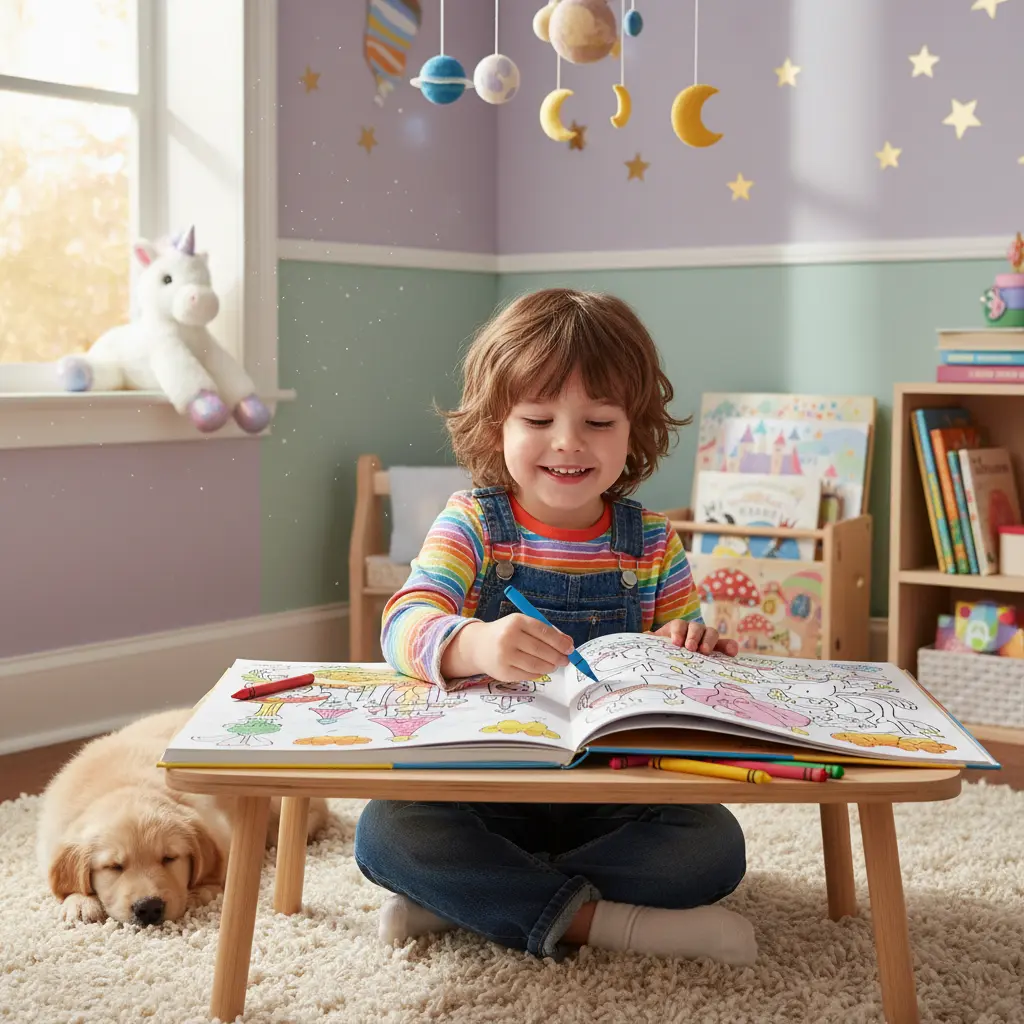
Motor Skills Developed Through Coloring
- Fine motor control: Repeated coloring movements strengthen the intrinsic muscles of the hand, preparing children for writing.
- Pencil grip: Regular practice with crayons and colored pencils helps children develop the tripod grip essential for handwriting.
- Hand-eye coordination: Guiding a crayon along lines trains the brain to coordinate visual input with physical movement.
- Bilateral coordination: Holding the paper with one hand while coloring with the other develops both sides of the body working in tandem.
- Spatial awareness: Coloring within defined boundaries teaches children to understand and respect spatial limits.
Occupational therapists often prescribe coloring activities for children with developmental delays or fine motor challenges precisely because it makes therapeutic exercise feel like play. For typically developing children, these same benefits build a solid foundation for writing, drawing, cutting, and other precision tasks.
For older children, colored pencils designed for kids offer better control and precision, further improving fine motor development.
3. Coloring as a Powerful Learning Tool
Coloring books are far more than artistic activities—they are dynamic educational tools. When children color images of letters, numbers, animals, historical figures, or scientific concepts, they engage with information in a multi-sensory way that significantly improves retention.
Educational Benefits Across Key Subjects
- Literacy: Alphabet coloring pages reinforce letter recognition and phonics awareness.
- Numeracy: Number-themed coloring builds early math concepts and counting skills.
- Science: Coloring diagrams of plants, animals, and the human body supports STEM learning.
- Geography & Culture: World map and cultural coloring books introduce children to diverse societies.
- Focus and attention: Completing a coloring page from start to finish trains sustained concentration, a core academic skill.
- Color recognition and categorization: Among the earliest cognitive skills, color identification is directly reinforced through coloring activities.
Studies in educational psychology show that multisensory engagement—seeing, touching, and actively working with material—boosts memory consolidation. Coloring a picture of the water cycle, for example, is far more memorable for a child than simply reading about it. This is why educational coloring books are staples in kindergarten and early elementary classrooms worldwide.
4. Emotional Development and Mental Well-Being
Perhaps the most profound—and least discussed—benefit of coloring for children is its impact on emotional regulation and mental wellness. In the same way that mindfulness practices benefit adults, coloring provides children with a calming, focused activity that helps them process emotions, reduce anxiety, and develop self-regulation.

Emotional and Psychological Benefits
- Stress reduction: The repetitive, rhythmic motion of coloring activates the parasympathetic nervous system, inducing calm.
- Emotional expression: Children who struggle to verbalize their feelings can use color choices as a form of non-verbal communication.
- Self-esteem: Completing a coloring page provides a tangible sense of achievement and pride.
- Mindfulness: Coloring demands present-moment attention, teaching children early mindfulness skills.
- Therapeutic outlet: Art therapists widely use coloring with children who have experienced trauma or anxiety.
- Social bonding: Coloring together—with parents, siblings, or peers—fosters connection and shared joy.
Child psychologists note that giving children a predictable, low-pressure activity like coloring can be especially beneficial during transitions—starting a new school, adjusting to a sibling, or managing family stress. The act of creating something beautiful provides a sense of agency and control that is deeply reassuring for young children.
5. Screen-Free Development: A Digital Detox That Benefits the Whole Child
In an era where children average over four hours of screen time per day, coloring books offer a rare, enriching alternative that engages the brain without the stimulation overload of digital devices.
- No blue light exposure means better sleep quality—particularly valuable in evening routines.
- Coloring builds patience and tolerance for slower, more deliberate activities.
- Physical interaction with materials (paper, crayons, pencils) develops tactile intelligence.
- No notifications, no algorithms, no pressure—just creative flow.
- Parents and children can participate together, with no generational skill gap.
Pediatricians and child development experts consistently recommend incorporating regular screen-free creative activities into children’s daily routines. Coloring books are among the most accessible, affordable, and effective ways to achieve this.
Creating a dedicated coloring space, such as a children’s activity table, encourages longer focus and reduces screen dependency.

Tips for Maximizing the Benefits of Coloring for Your Child
- Choose age-appropriate books: Simple, large designs for toddlers; detailed, themed pages for older children.
- Offer quality materials: Good-quality colored pencils or crayons provide better control and more satisfying results.
- Make it a routine: 15–20 minutes of coloring a few times a week yields consistent developmental benefits.
- Color together: Sitting down to color alongside your child multiplies the social and emotional benefits.
- Display the results: Showing off finished artwork builds confidence and signals that creative work has value.
- Connect coloring to learning: Use themed coloring books tied to current school topics to reinforce classroom learning.
- Avoid over-directing: Resist the urge to correct your child’s color choices—autonomy is part of the benefit.
This article contains affiliate links. If you purchase through these links, we may earn a small commission at no extra cost to you.
Conclusion: A Crayon Is More Powerful Than It Looks
The benefits of coloring books for children are anything but trivial. From strengthening the tiny muscles in a toddler’s hand to providing a teenager with a healthy emotional outlet, coloring is a multi-dimensional developmental activity wrapped in the simplest of formats.
As parents, educators, and caregivers look for meaningful, screen-free activities that support whole-child development, coloring books stand out as a timeless, research-backed solution. They build creativity, sharpen motor skills, accelerate learning, and nurture emotional well-being—all at once, all through play.
In a world that often overcomplicates childhood development, sometimes the most powerful tools are the simplest ones. A coloring book. A fresh box of crayons. And a child given the freedom to create.